

🍄 We're away at All Things Fungi Festival this weekend 🍄
‼️Orders after 12pm Thursday the 17th
will not ship until Monday ⚠️
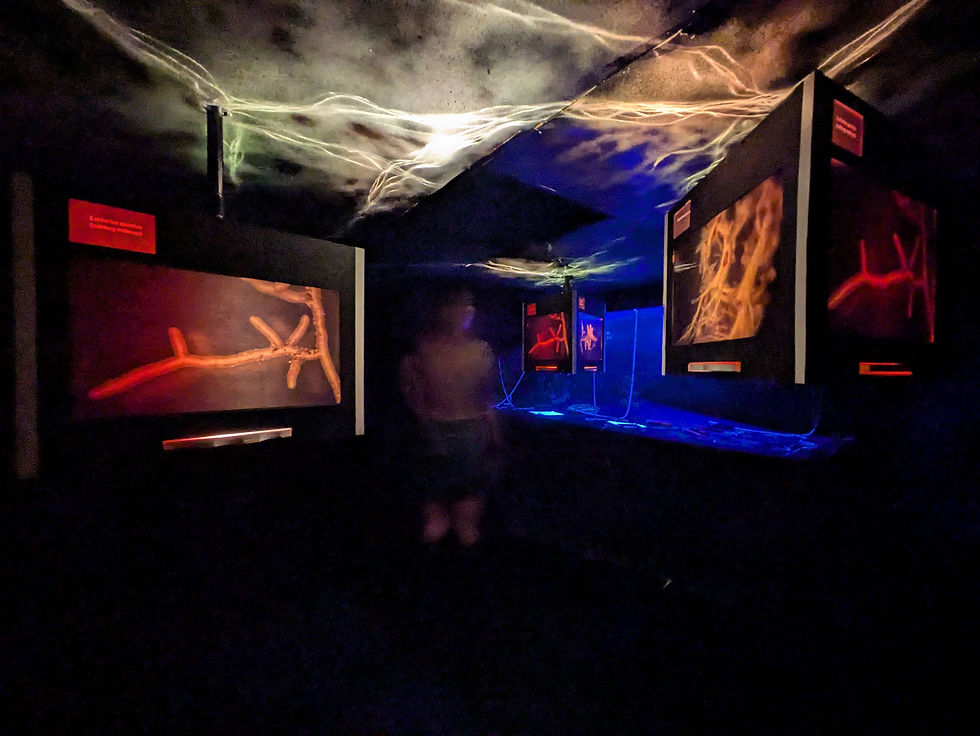
(un)common threads exhibition 2025
With funding from the British Mycological Society’s Massee Arts Grant and support from London National Park City, we’ve collaborated with artist Poppy Flint and creative technologist Benji Bailes to create an exhibition that weaves together art, science, and community. The project celebrates the hidden beauty of mycorrhizal fungi and their vital role in connecting forest ecosystems and combating climate change.
The exhibition features microscope imagery by Dr. Laura Suz (Royal Botanic Gardens, Kew) and an original fungal soundscape by Lex Kosanke, and invites visitors to contribute to a collaborative, ever-evolving artwork.

The research behind art work
‘Mycorrhizas are symbiotic partnerships between plants and fungi that have been shaping the Earth’s carbon cycle for 500 million years’
However, the ecological conditions in which that symbiosis exists have been subjected to significant changes due to human activity in a mere 150 - 200 years.
(un)common threads is inspired by research by Dr Laura Suz and her team into how these ancient, carbon sequestering ectomycorrhizal fungi are being impacted, and knock on consequences.
They studied forests that are part of the ICP Forest network - the International Co-operative Programme on Assessment and Monitoring of Air Pollution Effects on Forests. Data has been gathered from over 6000 ICP forest plots since the programme was established in 1985 making it a vital resource for identifying trends and changes over time and location.
Researchers took 13,000 soil cores from 137 ICP forest plots of oak, beach, spruce and pine trees in 20 countries - nearly 40,00 mycorrhizas were identified by DNA fingerprinting. The images in the installation were taken by Dr Suz during the process of visually examining the ectomycorrhizas collected in 22 oak sites across 9 countries and they show how these fungi explore the soil through their rhizomorphs and hyphae.

The research revealed that there are five key changing factors in the forests that are affecting ectomycorrhizas including mean annual air temperature or forest floor pH. Nitrogen ‘throughfall- deposition’ came out on top as the most critical factor negatively impacting the fungal communities in the roots of trees.
Deposition is the movement of substances in the atmosphere onto the soil, in this case, through the forest canopy. Atmospheric nitrogen has increased due to industrial activity such as farming, power generation and aviation and the deposition occurs relatively close to the source - the highest recordings in Europe are in Germany, Belgium and the Netherlands, England is in the middle range and Scandinavia is mostly still at pre-industrial levels.
Some fungi are tolerant to the increased nitrogen, known as nitrophilic. They thrive in the polluted soil therefore replacing the fungal species that are sensitive to nitrogen, or nitrophobic. Typically nitrophobic fungi have medium to long-distance hyphae and specialised rhizomorphs; by growing more biomass in the soil, they are drawing more carbon down from their tree associates.
‘Worryingly, some of the fungi most sensitive to high nitrogen are those that pump more carbon into the soil.’

The research is pointing to a tipping point for forests influenced by increased nitrogen deposition. It leads to changes in tree ectomycorrhizal communities which influences tree mineral nutrition. If mycorrhizal communities in the roots of trees change too much and are not able to provide trees with the nutrients they need, once forests cross this tipping point, it might not be possible to reverse by only reducing nitrogen levels. A new ‘normal’ within the ecosystem could have been established and the consequences of this are as yet unknown.
However, researchers in Laura’s team have re-sampled a subset of those forest sites for ectomycorrhizas after more than 10 years of the initial sampling. They will now be able to assess if after a decrease in nitrogen deposition, mycorrhizal communities have been able to recover.
The belowground world is so enticing from a creative and scientific perspective because there are so many questions yet to be defined, let alone answered.
‘It is important that we continue to investigate the soil ‘black box’ and establish the consequences of human activities on the organisms that drive many vital ecosystem processes, and whether and how these effects can be predicted, mitigated or reversed.’
The research reinterpreted
(uncommon threads) includes 6 different images of ectomycorrhizas in oak roots showing rhizomorphs and hyphae. This is a tiny fraction of the fungal species found in a healthy forest and most of the fungi pictured will associate with a variety of different trees.
Two nitrophilic (fungi that thrive where there are high levels of nitrogen in air pollution) are dominant in the installation with 7 of the 12 images being of just these two species - Xerocomellus pruinatus (matt bolete) and Lactarius quietus (oakbug milkcap).


When visitors light up just one or two different species a forest environment with high nitrogen pollution levels is represented through the lights and sound. As visitors discover how to create a more diverse scene with 3 or 4 different species lit up, the environment shifts and layers up to reveal a balanced, lively forest with low levels of nitrogen pollution.

There are no ‘good’ or ‘bad’ fungi, or one correct version to ‘win’. The natural world isn’t as simple as that. Through diversity and complexity we have richness and resilience.

Fungi, in their myriad forms underpin human life and are present in all habitats around the world. The canopy in (un)common threads is a mycelial web expressing the delicate interconnectivity within eco-systems. While not a literal representation it is based on research by Dr Susan Simmard and Kevin Beiler showing the linkages between Douglas-fir trees through the mycorrhizal network.
“Life did not take over the world by combat, but by networking.” -Lynn Margulis
In the scientific community there is a view that the concept of the fungal wood wide web - of trees being connected and communicating via mycorrhizal fungi - has maybe over-stretched the scientific reality. Regardless of this debate, we see the wood wide web as an important metaphor for sparking curiosity and starting people out on a journey learning about symbiosis and cooperation.
UK Native Mushrooms: Ecology, Nature & Conservation
As part of the exhibition, we highlighted several important and interesting species of UK native fungi through a photography exhibit by Rosie Foxley-Wood.

The UK is home to an astonishing variety of fungi, with over 15,000 species, ranging from tiny Mycena just a few millimetres high, to large long-living brackets clinging to ancient trees. Fungi play crucial roles that keep our landscapes, wildlife, and even ourselves alive. As nature’s recyclers, saprotrophic fungi break down wood, leaves, and organic matter, releasing nutrients back into the soil. Mycorrhizal species form close partnerships with plant and trees, attaching themselves to roots exchanging water and minerals for sugars. These hidden connections support everything from ancient oak woodlands to city parks. Fungi also sustain wildlife: countless insects, mammals, and birds rely on them directly for food and shelter. Without fungi, ecosystems would grind to a halt.
This diversity reflects the many different habitats found across Britain. Grasslands host colourful waxcaps, coral fungi, and earthtongues, often in meadows that have escaped modern agricultural intensification. Ancient woodlands shelter chanterelles, boletes, milkcaps, and a wealth of specialist fungi that thrive only in association with certain tree species. In Atlantic hazelwoods, for example, the fiery milkcap forms a dominant partnership with hazel trees, appearing wherever hazel grows and likely playing a key role in the tree’s success. Ancient Oaks, meanwhile, often harbour the beefsteak fungus, that helps break down oak heartwood, supporting a richer community of fungi and invertebrates and also increasing the tree’s stability and longevity. Beyond woods and meadows, fungi also flourish in moorlands, wetlands, and even urban parks, each habitat adding its own species adapted to particular soils and microclimates.

Humans also have a long history of relationships with mushrooms through folklore, cuisine, art and medicine. Folklore is filled with fungal imagery: fairy rings of field mushrooms and waxcaps were believed to be the dancing grounds of fairies, witches, or even the Devil, and stepping into one was said to bring misfortune or enchantment. In rural traditions, mushrooms often carried both wonder and suspicion — some were valued as food, while others were feared as poisonous or otherworldly.
Medicinally, fungi have played important roles as well, from traditional healing practices to modern medicine. Penicillin, discovered by Alexander Fleming in London in 1928, is the most famous fungal-derived medicine, sparking the antibiotic revolution. Today, fungi continue to inspire research into treatments for high cholesterol (statins), immune disorders, and cancer. Yet the majority of fungal species in Britain remain poorly studied. Conserving them is not just about protecting woodland habitats and biodiversity; it is also about safeguarding a vast, untapped resource for science, medicine, and culture.
Despite their importance, UK fungi face serious threats. Habitat loss through woodland clearance, urban expansion, and agricultural intensification has reduced fungal habitats. Pollution, pesticides, climate change, and invasive species add further pressure, with some native mushrooms now rare or endangered. Protecting fungi means protecting their habitats—ancient woodlands, old grasslands, hedgerows, and wetlands. Avoiding unnecessary disturbance, supporting conservation projects, and recording sightings through citizen science all help safeguard their future.
Want to get involved?
Record the fungi you find
i-naturalist contains over 521,000 observations of fungi of the British Isles.
You can learn help others learn more about the fungi of the UK by
recording your own findings on the iNaturalsit app.
Support the FFF Initiative
The Fungi Foundation are advocating for ‘funga’ as a collective term to be used alongside flora and fauna in order to elevate the status on fungi in environmental protection. They call upon people to educate themselves, use the term to educate others and sign their petition.
Explore our fungal world
SPUN (Society for the Protection of Underground Networks) has produced an online Underground Atlas. You can explore the distribution of mycorrhizal fungi and biodiversity hotspots around the world with detailed predictions for each 1 km2 .
The British Mycological Society (BMS) is the leading organisation for fungal research, identification and education in the UK. They offer resources for foragers and enthusiasts.
Royal Botanical Gardens, Kew in London is home to The Fungarium, one of the largest collections of fungi in the world. Researchers study fungi native to the UK fungi from around the world to understand their ecological roles, conservation and potential uses.
The Lost and Found Fungi Project began in 2014 and focused on fungi that have been rarely recorded, carrying out targeted surveys to establish whether they are still there, and if so whether they are genuinely rare or merely under-reported.


